
'How and if India retaliates will go a long way toward determining the trajectory of this crisis.'

'In a relationship that does not permit cricket, how can the prime ministers embrace and send a false message,' asks Ambassador T P Sreenivasan.

The outcome of the Bangkok NSA-level talks underscores that Pakistan has got exactly what it wanted -- talks at different levels, talks on Kashmir, talks on mutual concerns regarding terrorism, talks on ceasefire on the border. What if any has been India's gains remains unexplained, says Ambassador M K Bhadrakumar.
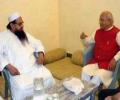
'There are all sorts of characters moving around acting as unofficial representatives of the government and engaging in their own personal foreign policy initiatives. Clearly, the government needs to shut these characters down if it wants to continue enjoying any credibility, both domestically and internationally,' says Sushant Sareen.

Obama's decision to visit India must be a result of his judgement that Modi is a man of action, feels Ambassador T P Sreenivasan.
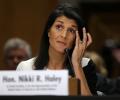
If confirmed by the US Senate, Haley, 44, would be the first Indian-American to serve in a Cabinet-level position in any presidential administration.
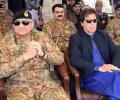
'Any conventional conflict could trigger a nuclear war with results that neither India nor Pakistan could survive easily.' >A revealing excerpt from Shuja Nawaz's The Battle For Pakistan: The Bitter US Friendship And A Tough Neighbourhood.

In a rare move that might end the chronic impasse between arch-enemies the United States and Iran, President Barack Obama could meet his Iranian counterpart Hassan Rouhani on the sidelines of the United Nations General Assembly.

'Xi's emphasis on enhancing conventional military deterrence capabilities, joint operations and power projection are likely to increase friction points with India as with other nations,' points out China expert Srikanth Kondapalli.

After Pyongyang tests a missile potentially capable of reaching the US, Dr Rajaram Panda explores the realistic -- and peaceful -- options before Donald Trump and the international community at large.
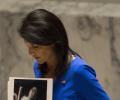
North Korea considers Assad's Syria an ally, so it views Donald Trump's decision to strike Syria as a message to Pyongyang as well.

In his last column for Rediff.com, Praful Bidwai joins issues with those lauding India's covert operation against Naga rebels based in Myanmarese territory.

Sunit Nair writes about what he thinks of his Father -- the word, the idea and the person.

It was clear in Brunei at the 8th East Asia Summit that China doesn't want the South China Sea issue to even dominate the discussion, reports Sheela Bhatt, who is part of the prime minister's media contingent to the summit

'All this talk of 'tactical nuclear weapons' or a limited nuclear war are 'false flags'! It looks like India and Pakistan are slowly but surely inching towards this realism,' says Colonel Anil A Athale (retd).

Modi also said the people of India felt proud that President Xi has twice received him out of the capital.

This is the first time Pakistan and Kashmir have been brought into the narrative.

The G-4 foreign ministers' grouping, that includes India, on Thursday called for urgent reform of the United Nations, including the Security Council, an issue that India has emphasised for the past several years.

'Modi's abject capitulation will play out badly in his core constituency.' 'The bulk of our strategic community is under the impression that India under Modi has already become a superpower.' 'They don't even want to look at the country's emaciated limbs or its asthmatic problems,' says Ambassador M K Bhadrakumar.

'Modi's promise of change during the election campaign was on the domestic front, but his first year in office focused on foreign policy beyond all expectations,' says Ambassador T P Sreenivasan.

The counter-insurgency operation on the Indo-Myanmar was under planning for the last three months. The June 4 ambush that killed 18 Indian soldiers only hastened the attack. Sheela Bhatt provides exclusive details of the planning for the operation.

'Washington is telegraphing here is its willingness to support a low-grade, limited use of force meant to send a strong message to Pakistan.' 'Perhaps something along the lines of the surgical strikes in 2016, or perhaps something a bit more -- but not much more.'

The India-Afghanistan relationship does not have to be a template of each country's relations with Pakistan, and Delhi will do well to leave it to Ghani to redefine the parameters of Afghanistan's security cooperation with India. A zero-sum mindset can only exacerbate regional tensions, says Ambassador M K Bhadrakumar.
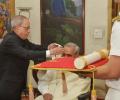
Former PM Atal Bihari Vajpayee was on Friday conferred with the Bharat Ratna.

The joint statement issued after Prime Minister Narendra Modi and President Barack Obama's first-ever summit is high on intent and ambition. Notably missing from the statement is India's refusal to be America's partner in its war against ISIS.

United States Special Representative for Afghanistan and Pakistan James Dobbins, who was in New Delhi on Thursday said in an interaction with the press that improvement in Indo-Pak ties will automatically improve the situation in Afghanistan, even as he discussed the current state of play in US-Afghan relations and attempts to work towards reconciliation with top officials.

'We will have to wait till the snows melt in June/July 2016 before we can get a clearer idea of whether Pakistan intends to get serious about ending support for cross-border terrorism,' says G Parthasarathy, India's former high commissioner to Pakistan.

"Will anybody want a servant that who is on vacation when needed at home? And nobody knows where he is," he continued.
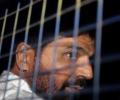
'The cooperation of Yakub with the investigating agencies after he was picked up informally in Kathmandu and his role in persuading some other members of the family to come out of Pakistan and surrender constitute, in my view, a strong mitigating circumstance to be taken into consideration while considering whether the death penalty should be implemented,' B Raman had written in August 2007.
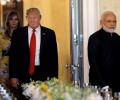
'China was the elephant in the Oval Office and Trump would have sensed that Modi's foreign policy architecture has become disoriented sans the US' pivot to Asia,' points out Ambassador M K Bhadrakumar.

Moving ahead with their new mantra -- Chalein Saath Saath: Forward Together We Go -- Prime Minister Narendra Modi and United States President Barack Obama on Tuesday vowed to deepen cooperation in every sector for the benefit of global stability and people's livelihoods over the next ten years.
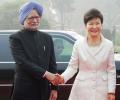
South Korean President Park Geun-hye's visit to India will enhance economic and military ties between the two countries and give the relationship a strategic dimension, says Jiye Kim.
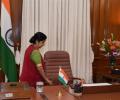
Sushma Swaraj, like Clinton, has a strong political base in her own party and is likely to have her imprint on foreign policy, says Ambassador T P Sreenivasan.
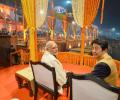
'Modi and Abe are working seriously for India-Japan bonhomie to grow stronger.' 'It is a win-win situation for both countries and the future look promising,' says Rajaram Panda, the Indian Council for Cultural Relations India Chair Visiting Professor at Reitaku University, Japan.

'The Modi government's lurch toward America has not brought it any dividends so far. The Western world is simply not in a position to make big investments in India... India needs to take a leap of faith vis-a-vis China.'

'India should think big: About how in a multi-polar world, India can indeed be one of the poles, rather than being a secondary power that has to worry about 'alignment' with one of the poles. A G3 in other words, India should look to getting others to align with itself rather than the US or China,' says Rajeev Srinivasan.

Amid souring ties, the president visited Beijing for three days. On his return to India, a hope of better ties has arisen, says senior correspondent R Rajagopalan, who travelled with Pranab Mukherjee to the Asian superpower.

It is time the new government, unencumbered with the burden of past, initiates a wide ranging review and open debate on the security issues to rectify our short term and long term shortcomings. It has taken some wise steps but has to go beyond this to identify the structural weakness and create systems, says Colonel (retd) Anil Athale.

Here's the full text of Prime Minister Narendra Modi's address to the United States Congress.
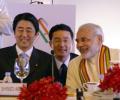
'Both nations have a common problem: A rampaging, jingoistic and hostile China which is making substantial territorial claims. In the long run, Japan and India are going to be the victims of Chinese aggression -- so they might as well hang together to contain China,' argues Rajeev Srinivasan.
